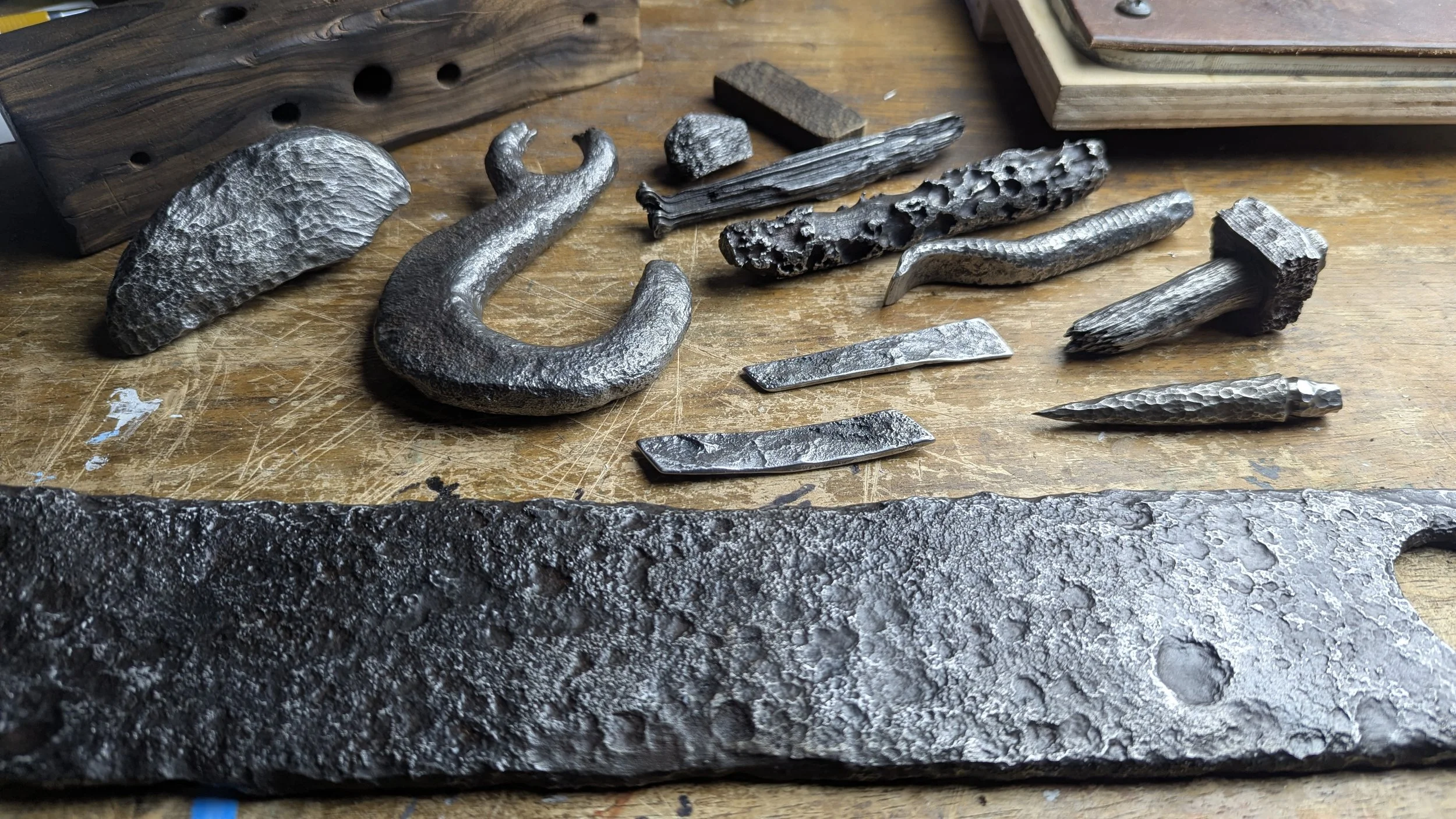
Wrought iron wrought by time.
Haphazardly discarded long ago these bits of industrial hardware have been sculpted by many decades of marine corrosion. These hazards were recovered from inevitable decay and meticulously preserved as an act of appreciation for their embodiment of history, form, function, and nature’s way.
Each object tells a story of America’s industrial pursuit for resources and how no matter the level of environmental damage we inflict, natural processes will eventually destroy those efforts and turn the heaviest of steel machines back into the ore we originally mined.
I consider my work in preserving these objects a temporary pause in their eventual decay. Even in this cleaned up and oiled state the process of oxidation will try to penetrate any protective layers we apply if left untouched. However, the simple act of holding and feeling these objects in our hands as often as possible replenishes that layer of protection.
Each object is revealed by cracking open a rust, sand and rock concretion formed by decades of corrosion.
The term wrought iron, is used commonly to describe range of solid metal products typically built by a blacksmith’s such as ornamental gates, balconies, railings, etc. However wrought iron is actually a specific iron material that is historically significant but is no longer made commercially since the 1960’s. Nearly all modern “wrought iron” products are NOT made from actual “wrought iron”, but made from mild steel.
If a blacksmith made two gates of similar design, one from mild steel and the other from true wrought iron they would look identical as first. However, after fifty years of use and exposure to the weather, the mild steel gate would be mostly rusted away and the hinges broken while the wrought iron gate would still be fully functioning now with a beautiful corrosion pattern similar weathered pine.
Wrought iron contains needle-like silica inclusions that guide the corrosion of the iron which results in it’s distinct wood-like grain. These inclusions and other desirable properties result from the fascinating wrought iron making process which is ancient, labor intensive, technically challenging and low yield.
The reasons
However if those products were made after the 1960’s they would have been made with mild steel because the material wrought iron was no longer commercially manufactured.
of the Often, but not always, the original function of the objects can be deciphered underneath the layers of and various corrosion patterns.
All objects considered wrought iron must show a distinctive corrosion pattern called layered striation that visually resembles a stringy grain similar to wood. Depending on the quality of the wrought iron visible layered striations varies greatly, from barely visible linear ridges to deeply splintered and splitting iron needles. Layered striations also terminate in a similar way at opposite ends of the object with deep pitting and needlelike points.
There may occasionally be objects for sale that do not show any visible layered striations and will clearly be marked as not wrought iron.
Values are determined by the aesthetic the corrosion patterns compliment the objects form. Certain object forms are quite rare impacting its valuation.